PROVISION1 SYSTEMS ENGINEERING LABORATORY

Sovereign™ Professional Audio Conditioning Matrix

DETERMINISTIC AUDIO CONDITIONING INFRASTRUCTURE FOR PROFESSIONAL DEPLOYMENT

ENGINEERING MOTIVATION & DUAL-EMISSION ARCHITECTURE

Modern digital production workflows—including DAW exports, AI-generated material, lossy compression, streaming masters, and legacy PCM recordings—can exhibit brittle transients, diffuse stereo imaging, inconsistent low-frequency authority, and listener fatigue. Sovereign™ introduces a deterministic conditioning stage that restructures these behaviors prior to final deployment.

Crucially, Sovereign™ operates via a dual-emission architecture: every processing pass simultaneously generates both the peak-bounded deployment master (.wav) and a high-resolution 4-pane structural engineering audit artifact. The audit is not an optional post-process report—it is a parallel diagnostic evidence layer emitted directly from the conditioned signal state.

1. Before Sovereign / After Sovereign Operational Matrix

Source Material Typical Problems Expected After Sovereign
AI music Brittle highs, unstable stereo Smoother transients, stronger image
AI speech Thin, synthetic voice Increased vocal body
MP3 / Compressed Codec glare Smoother upper spectrum
DAW export Flat center Greater center focus
Streaming master Listener fatigue More relaxed presentation
Legacy PCM Inconsistent tonal density Improved spectral cohesion

2. Deterministic Processing Characteristics

Property Sovereign Engine State
Offline processing
Repeatable output
Fixed processing pipeline
No adaptive AI inference
Consistent deployment masters
Simultaneous dual-emission audit

3. What the Engine Conditions

Incoming Condition Sovereign Response
Brittle transient edges Envelope-derivative transient reconstruction
Thin center image Mid-band body reconstruction
Weak bass foundation Resonant LF reinforcement
Spatial instability Mid/Side restructuring
Digital harshness Memory-based saturation
HF glare Mass-controlled reconstruction filtering
Variable delivery level Peak-controlled deployment master
Unknown processing outcome Integrated 4-pane engineering audit image

4. Sovereign™ System Differentiation Matrix

Conventional Tool Category Primary Function Operating Principle Limitation Sovereign™ Differentiation
EQ Frequency amplitude adjustment Static gain changes across frequency bands Does not reconstruct time behavior or signal density Conditions spectral behavior as part of a larger deterministic structural pipeline
Compressor / Limiter Dynamic range control Gain reduction based on amplitude thresholds Controls level but does not address spatial or harmonic organization Preserves deployment level while restructuring transient and density relationships
Saturator Harmonic generation Nonlinear waveform distortion Adds harmonic coloration but lacks structural analysis Uses controlled nonlinear conditioning with state memory inside a documented pipeline
Exciter High-frequency enhancement Adds synthesized upper harmonics Often increases presence but may increase fatigue Conditions perceived clarity through coordinated spectral and temporal restructuring
Stereo Enhancer Spatial widening Phase, delay, or M/S manipulation Can enlarge image without improving source coherence Applies spatial restructuring as one stage within full signal conditioning
Transient Designer Attack/sustain modification Envelope shaping Alters dynamics without addressing tonal architecture Rebalances transient behavior relative to overall signal topology
Mastering Chain Final polish Collection of independent processors Results depend on operator choices and undocumented settings Produces repeatable deployment masters with generated engineering artifacts

5. Sovereign™ Operating Classification

System Type Sovereign State
Audio effect No
Creative coloration tool No
Adaptive AI processor No
Mastering preset No
Deterministic conditioning system Yes
Signal architecture transformation layer Yes
Deployment validation system Yes

6. Conditioning & Audit Workflow

Sovereign™ simultaneously generates a conditioned deployment master and an engineering audit record documenting the transformation state.
Source Asset
Deterministic Conditioning Engine
Conditioned Signal State
↙ Dual-Emission Layer ↘
Deployment Master .wav Audio Output
Engineering Audit 4-Pane Visual PNG Artifact
Stage 01
Source Asset
Ingestion of unconditioned source media or production stream.
Stage 02
Deterministic Conditioning
Oversampled nonlinear conditioning, differential transient reconstruction, mid/side structural processing, and resonant low-frequency augmentation.
Stage 03A
Deployment Master
Peak-bounded standardized master (.wav) emitted directly from conditioned signal state.
Stage 03B
Engineering Audit
Dynamic profile and spectral topology 4-pane visual record generated simultaneously from conditioned signal state.

Structural Audio Audit Artifacts
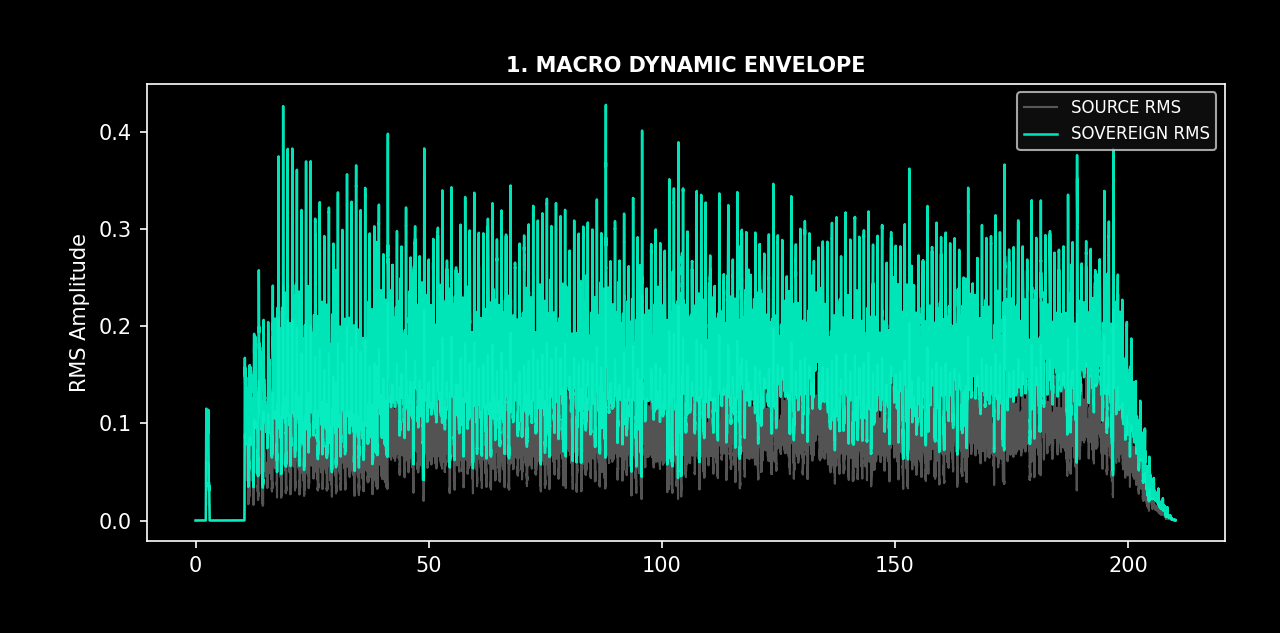
1. MACRO DYNAMIC ENVELOPE
Panel 01 (Code Output: axs[0])

MACRO DYNAMIC ENVELOPE (RMS Contour Analysis)

Visualizes the macro RMS amplitude contour over time, comparing the unconditioned source trace against the Sovereign conditioned output to map overall energy density and dynamic profile adaptation.
Temporal RMS energy contour telemetry.
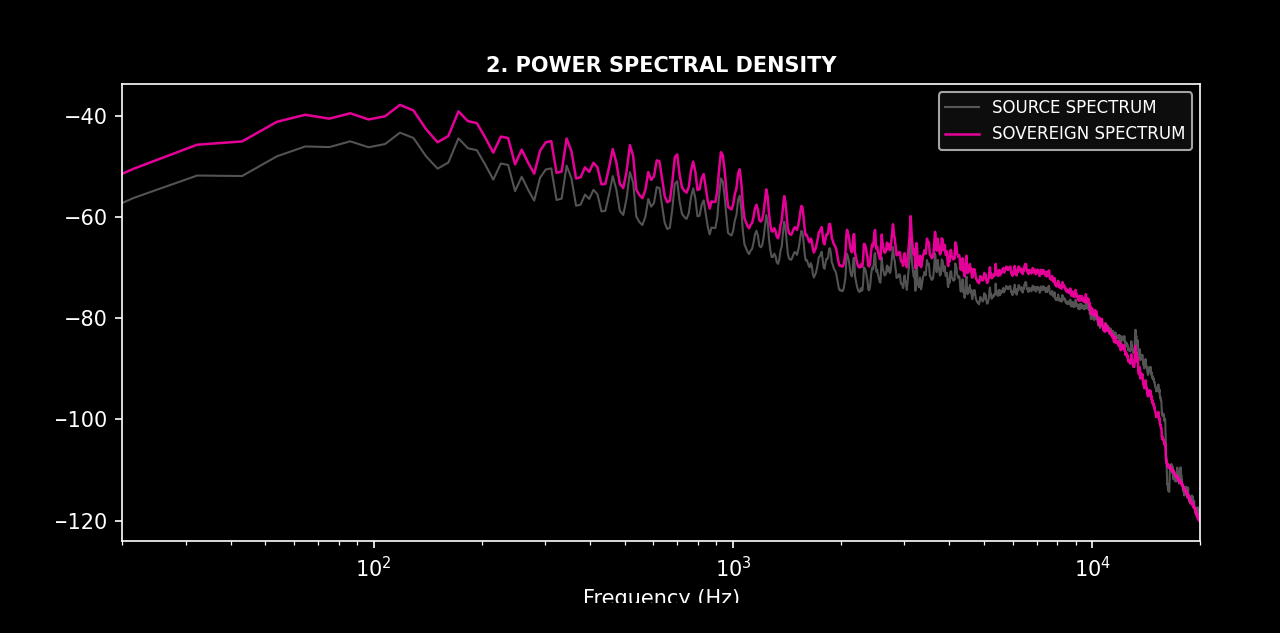
2. POWER SPECTRAL DENSITY
Panel 02 (Code Output: axs[1])

POWER SPECTRAL DENSITY (Welch's Method / Frequency Tilt)

Evaluates frequency distribution and spectral tilt using Welch's method across the full audio band, tracking energy shifts and spectral cohesion between the source and Sovereign spectrum.
Spectral energy distribution and frequency tilt topology.
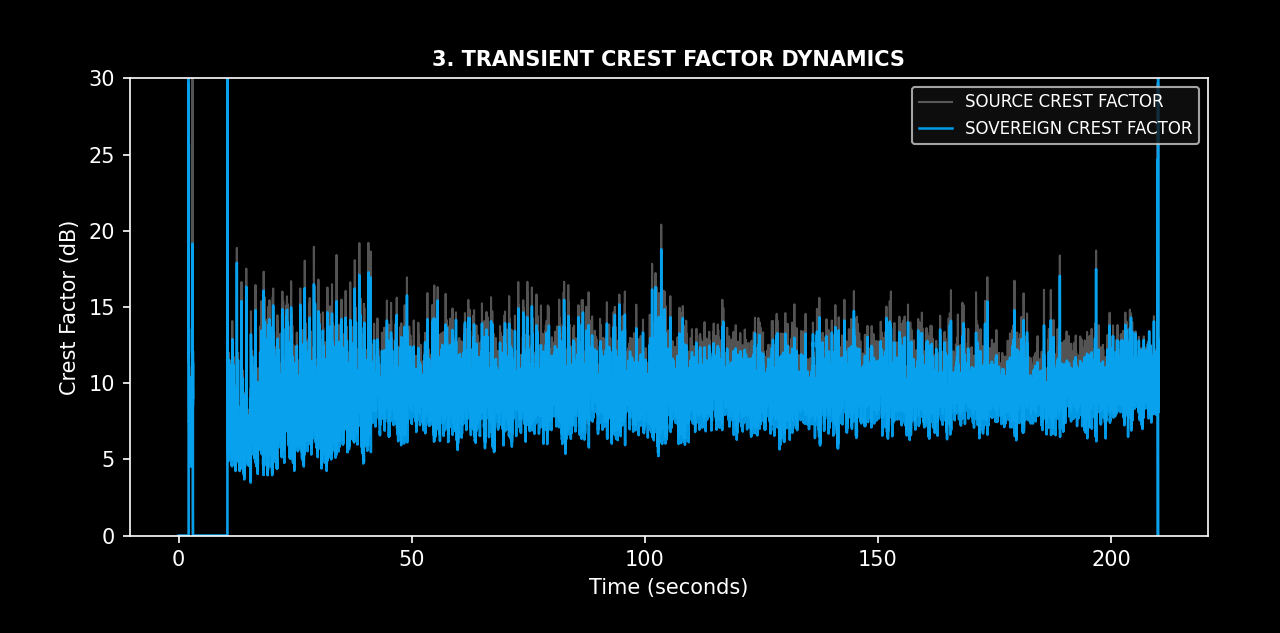
3. TRANSIENT CREST FACTOR DYNAMICS
Panel 03 (Code Output: axs[2])

TRANSIENT CREST FACTOR DYNAMICS (True Peak-to-RMS Ratio in dB)

Tracks the true peak-to-RMS ratio over time in decibels, contrasting source crest factor variance with the stabilized Sovereign envelope behavior to ensure bounded operational limits.
Crest factor stability and dynamic range tracking.
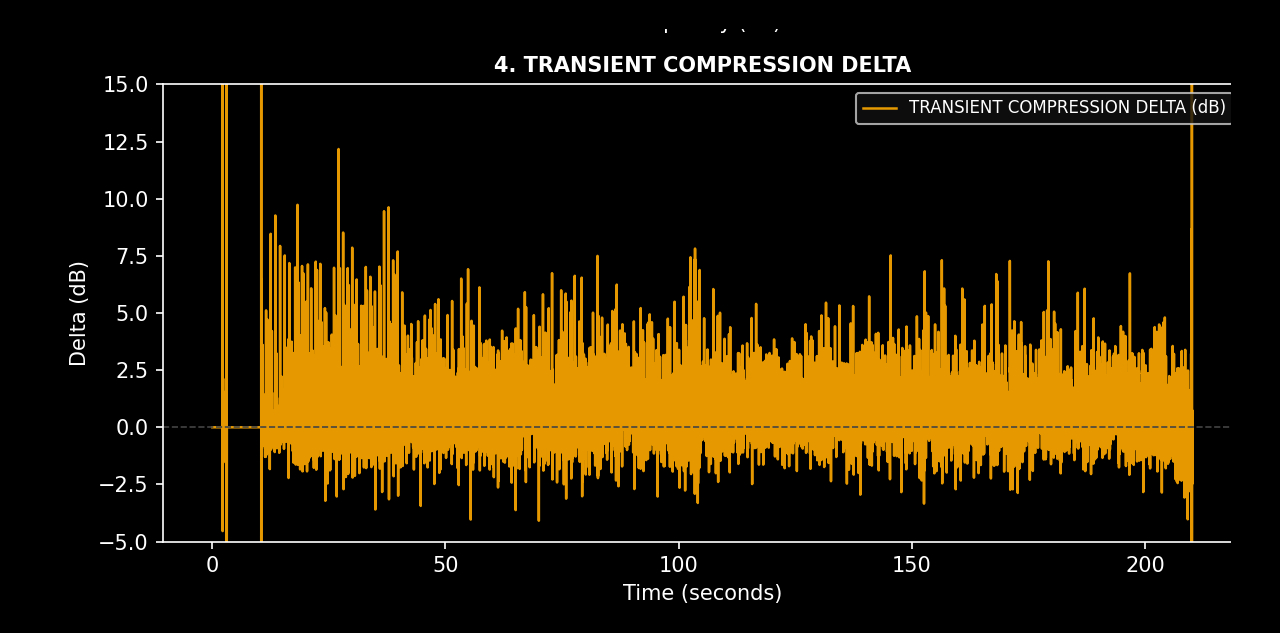
4. TRANSIENT COMPRESSION DELTA
Panel 04 (Code Output: axs[3])

TRANSIENT COMPRESSION DELTA (Dynamic Crest Factor Variance)

Maps the precise differential variance (delta) of the crest factor over time, exposing nonlinear clamping events, transient punch-through behavior, and algorithm stability.

Micro-dynamic variance and non-linear clamping telemetry.

7. Observed Operational Characteristics

Source Characteristic Observed Result
AI generated music More coherent stereo organization
AI voice Increased vocal body
Streaming masters Reduced perceived glare
DAW exports Improved transient cohesion
Legacy PCM Increased spectral continuity
Dense mixes Greater center definition
Thin playback systems Increased low-frequency authority